Best Robotic Kits for Engineering Students to Enhance Learning
Engineering is something you learn with your hands as much as your head. India turns out roughly 1.5 million engineering graduates every year, yet employers keep saying many of them struggle with practical, applied work. That gap doesn't close in a lecture hall. It closes on a workbench, with a loose wire, a stubborn sensor and a robot that refuses to turn left. This is why robotic kits for engineering students have become such a useful part of modern learning. The right kit turns textbook theory into something you can build, break and fix again.
Not every kit on the shelf deserves a place on your desk. A good one gives you room to grow. Look for a programmable microcontroller such as an Arduino-compatible board, a healthy mix of sensors and motors, and parts that can be rebuilt into different projects rather than one fixed model. Durable components matter too, because they will be pulled apart and reconnected many times. Many educational STEM kits look impressive in the box but run out of challenge after a weekend. The best ones keep asking harder questions as your skills improve.
If you are new to electronics, begin with a kit that teaches circuits, sensors and basic code together. A simple line-follower or obstacle-avoiding robot covers more ground than you might expect. Voltage, logic, loops and debugging all show up in one small project. This is the same step-by-step method that good STEM kits for schools use with younger learners, and it works just as well at university level because the fundamentals never change. Get these right early, and the tougher modules in later semesters feel far more manageable.
Once the basics click, move on to kits with robotic arms, servo control, wireless modules or IoT features. These let you explore kinematics, automation and even simple machine learning. Mechanical students get to see torque and motion in action. Computer science and electronics students finally get real hardware to test their code on. Advanced educational STEM kits of this kind also make brilliant material for final-year projects and hackathons, where a working prototype speaks louder than any slide deck.
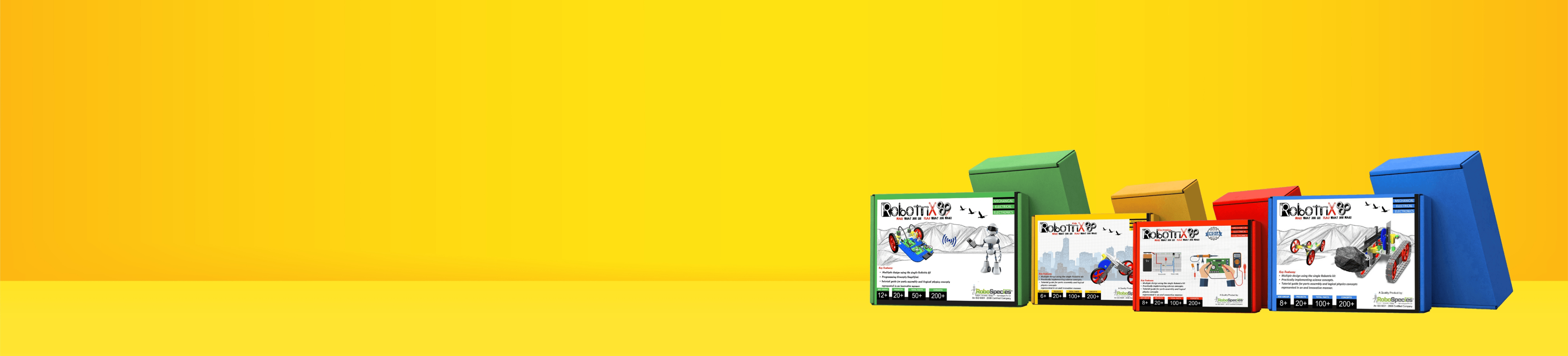
Hardware is only half the story. A kit paired with a simulation platform lets you test ideas before you wire anything, which saves both time and components. RoboSpecies, for example, offers TinkerBrix, a Scratch and Arduino simulation-based coding platform, alongside its Robotrix range, including the Senior and Electronica kits built for learners aged 12 and above. Kits backed by guided lessons and reliable technical help are simply easier to stick with. Institutions buying STEM kits for schools and colleges often choose this kind of complete bundle for that reason, since students keep moving forward instead of getting stuck.
The best learning happens when curiosity meets something you can actually hold. Choosing the right robotic kits for engineering students means thinking about growth, flexibility and the support behind the product, not just the price tag. If you want kits, curriculum and lab setups that are ready to use from day one, get in touch with RoboSpecies and book a demo to see what hands-on engineering learning really looks like.